To Solve Indy’s Housing Crisis: Local Government & Philanthropy must fund better development
A crisis born of racism and greed, kept alive by bad planning

The affordable housing crisis Indianapolis America is facing, is as much a design and planning problem as it is a moral issue of how much greed and exploitation is allowed in commoditizing basic needs like housing. It is a housing crisis born of racism and greed, perpetuated by bad planning and design. The housing crisis is a public safety crisis for Black Indianapolis that drives poverty, violence, misery, and death.
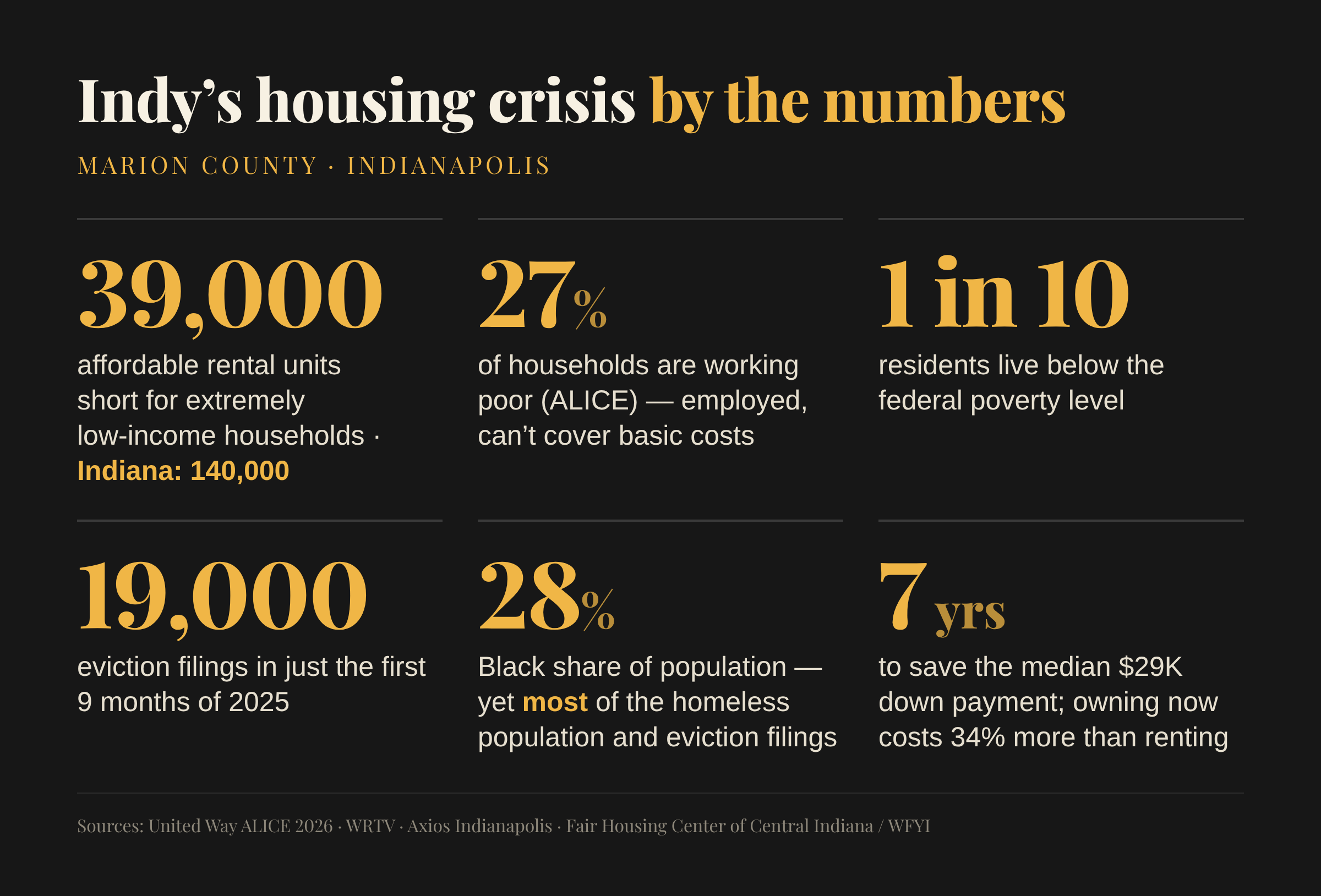
Addressing the Indianapolis metro area’s shortage of at least 39,000 affordable rental units for extremely low-income households in a state already 140,000 short is impossible without considering what led to this crisis. White metro Indy suburbs declaring an affordable housing crisis and Black homeownership plummeting lower than before the Civil Rights Act of 1968 outlawed redlining isn’t a singular misstep. Black residents making up most of the homeless population and eviction filings in Indianapolis despite being only 28% of the population is a symptom of the systemic issues around race and class that aren’t being adequately addressed by the city of Indianapolis and the philanthropic/nonprofit ecosystem.
In short, philanthropy and local government is often throwing good money after bad. To effectively address our housing crisis we must change the way we plan, fund and build affordable housing, from ownership models to the type of insulation in the walls.
Is sprawl the answer?
The United Way’s 2026 report shows that 27% of Indianapolis/Marion County households are Asset Limited Income Constrained Employed (ALICE). They are the working poor. Meaning they have jobs but the households earn less than the basic costs of housing, child care, food transportation, health care, technology, plus taxes but don’t qualify for public assistance. Over 1 in 10 Indy residents live below the federal poverty level that practically requires someone to have one foot in the grave. Optimistic initiatives from city government and nonprofits to make homeownership attainable to everyone have largely failed both groups despite them making up over a ⅓ of the population.
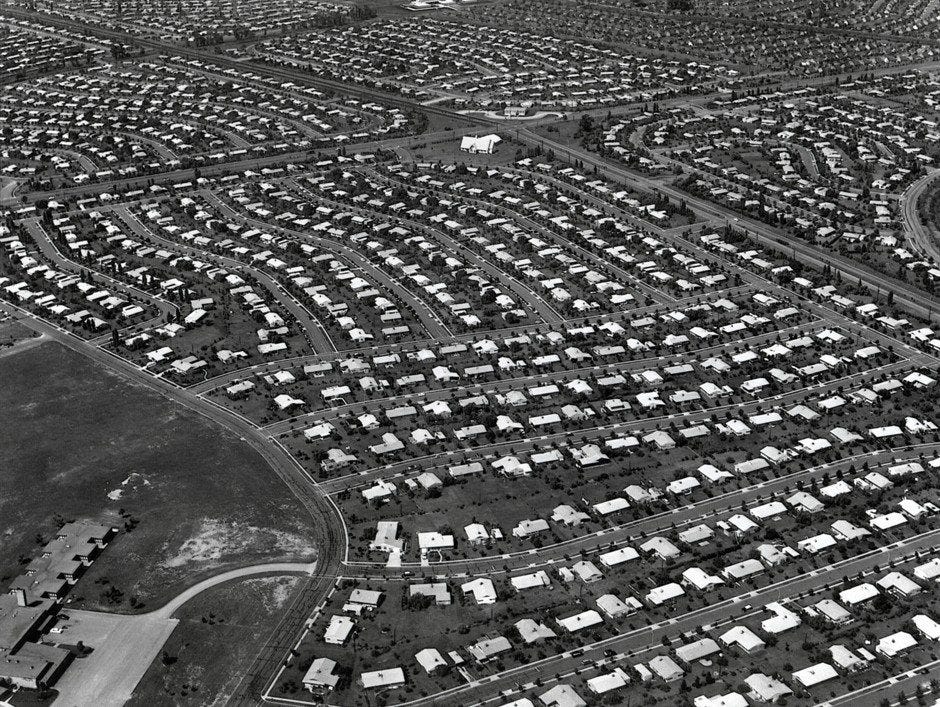
But failure to provide real opportunities for single family homeownership to low-income households is inevitable when it’s the most expensive and resource intensive way to house people. It’s relatively slow to build, uses more land than multi-family housing, and requires separate roofs, foundations, and utilities no matter the size of home. Multi-family housing/apartment buildings have been around for at least 9,000 years of human history and rented apartment units have been around for at least 2,300 years. Apartment buildings have been independently invented at least 5 or 6 times by different civilizations and have been found in historical sites in 5 different continents. Yet many politicians, nonprofits, and philanthropic funders only talk about improving access to single-family homeownership opportunities that induce sprawling cities, bigger highways and car dependency.
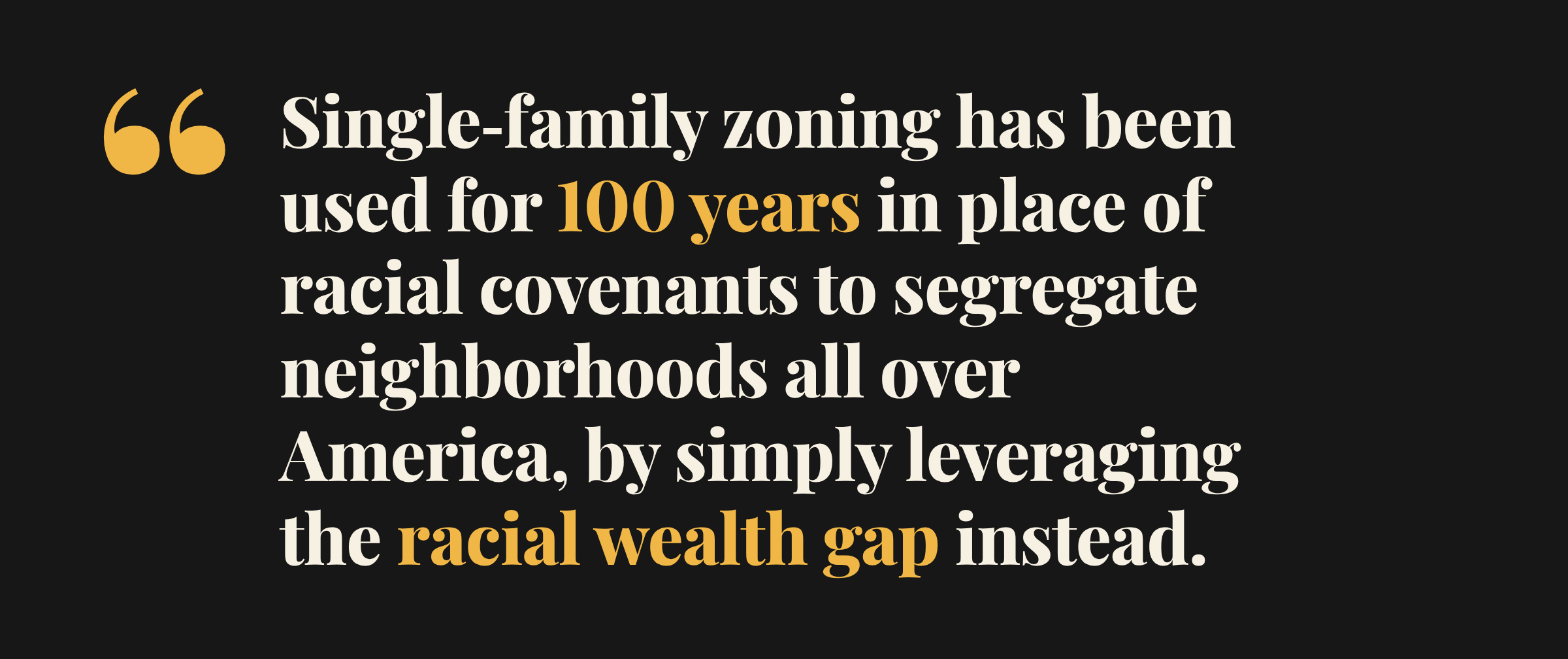
Single-family housing is so effective at being more expensive, that single-family zoning has been used for 100 years in place of racial covenants to segregate neighborhoods all over America, by simply leveraging the racial wealth gap instead. Single family zoning creates a socio-economic threshold that even the Indiana Legislature sought to address SB1001 because it slows down housing development that much. But the exclusiveness of single family homeownership neighborhoods have created a social bias against denser multi-family housing that make cities possible in the first place.
Is that why multi-family housing has not been the standard for municipalities and nonprofits to fund all along? Social bias around apartments dwellers supposedly being transients who don’t care about their communities as much as more affluent families that could invest in a home? Stigma against poor people that may never be able to afford their own home bringing property values down? Yes, that type of bias against the poor creeps into the fabric of our culture and it’s caused many to unknowingly make bad decisions regarding housing policy and funding.
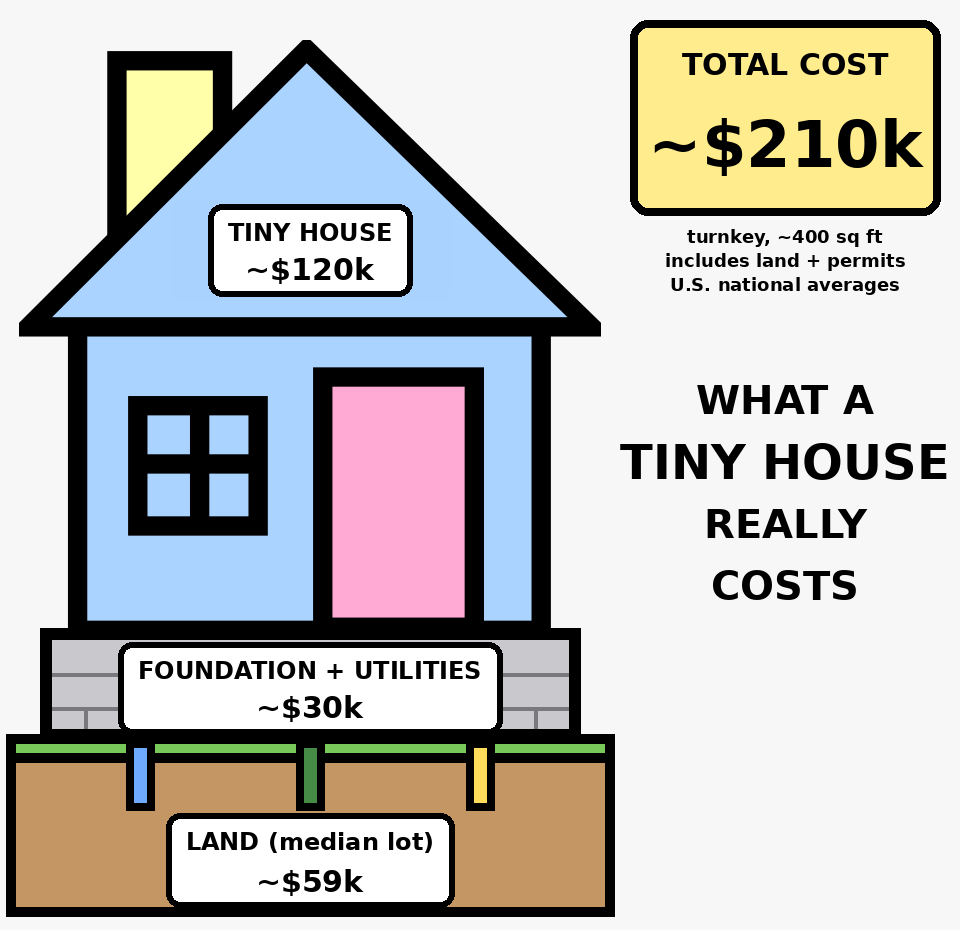
An extreme example of the limitations of single family housing are well intentioned initiatives to use the tiny-house movement to address housing shortages. The tiny-house movement promotes simplified living in small houses typically 400 sq ft or less. They’re often marketed as lower-cost, eco-friendly and a great option to house homeless individuals, but in most cases they’re the opposite. They’re more vulnerable to natural disasters, lack storage, can’t accommodate traditional appliances and make hosting guests difficult. Tiny-houses cost around $130K - $210K per home with land included in America just to house 1 - 2 people in long-term accommodations most would find uncomfortable. An apartment building is cheaper to build, heat and cool for anything over 15 - 20 units of housing. Building just 25 tiny homes is likely to cost well over $1 million more than a comparable apartment building with bigger units and use over 1.5 acres more land just to give everyone a small useless yard. Standard size affordable single family homes aren’t quite that expensive per person, but they’re expensive and at scale have similar cost disadvantages to build and operate over time.
For the last 70 years developments supported by local government and nonprofits have proven this by often focusing on redeveloping dense urban neighborhoods with (multi-family) missing middle housing into low density single-family neighborhoods. Sometimes they even used the popular suburban homes plans of the times. This type of low density infill redevelopment helped reduce urban populations so much that some neighborhoods could no longer support grocery stores, restaurants, shops or frequent bus service anymore. Which in turn drives further disinvestment and reduced city services because of a reduced tax base spread among too few people. Center township at the center of Indianapolis has less than half the population it was built for and actually held in the 1930s - 1960s.
When Indianapolis is short 39,000 affordable housing units devoting as many resources as we have over the years to single-family homeownership opportunities directly contributed to a housing and homelessness crisis. Producing more housing from missing middle housing types like townhouses, multiplexes and apartment buildings small and large is key to solving our crisis.
Funding planned obsolescence
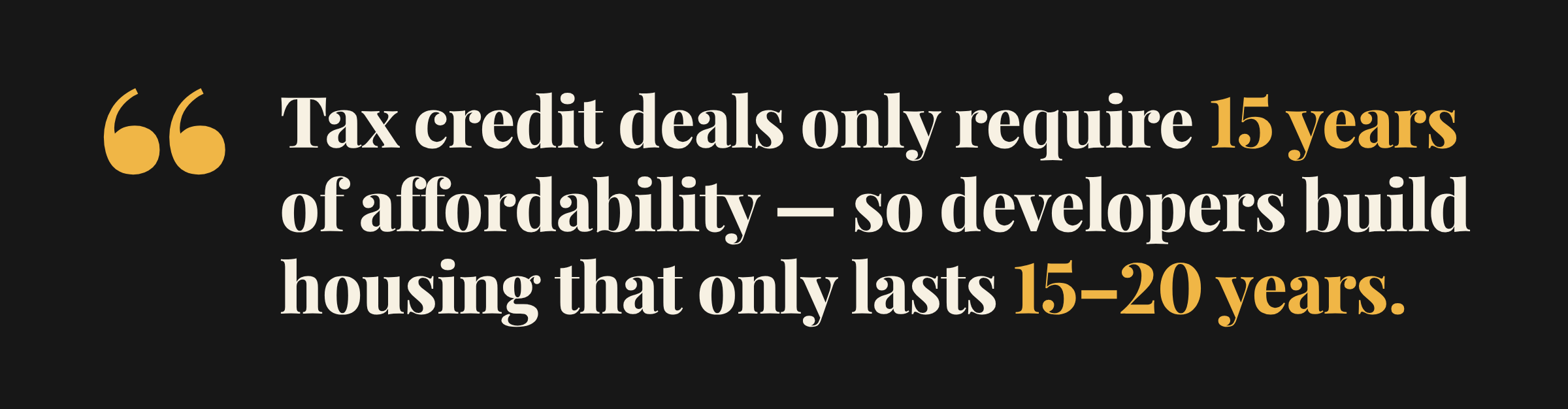
Much of the affordable housing development has also centered around poorly designed multi-family housing and single family housing. Housing that makes sure residents never forget they’re poor. The U.S Department of Housing and Urban Development (HUD) subsidizes development of affordable housing through the Low-Income Housing Tax Credit (LIHTC) and HOME program. These affordable housing tax credit deals only require a 15 year affordability (compliance) period or sometimes a 5 - 20 year affordability period. This incentivizes developers to build housing that only lasts 15 - 20 years until it’s sold off for market rate housing to a property manager that specializes in older buildings i.e. a slumlord or it is “resyndicated”. Resyndication is a fancy developer term for renovating and refinanced with more public subsidies and debt. It incentivizes building noisy, maintenance prone energy inefficient apartments, townhomes and single family homes.
But HUD has a long track record when it comes to monitoring and supporting the affordable and public housing it subsidizes, and that track record is awful. Pruitt-Igoe, Cabrini-Green, Robert Taylor Homes and so many other federal housing projects became the face for bad design, substandard workmanship and atrocious living conditions. Despite the early success it had with Lockefield Gardens in Indianapolis, HUD rarely achieved anywhere near that level of quality in later housing projects. They subsidized bad housing projects all over America that were locally designed and approved by HUD after making its own changes. Indianapolis was no exception.
We had Riverhouse and Stone-Key as disastrously executed local projects in the late 1960s. Riverhouse, a high rise complex, so poorly designed that families living in 3 bedroom apartments on the top floors overtook the plumbing causing apartments on the lower levels to back up with sewage. HUD also eliminated air conditioning to cut costs causing the upper floors to be uninhabitable during the summer as temperatures reached 137 degrees. Nonprofit leaders blamed frequently out of order elevators on the “lifestyle” of low-income residents, until an elevator opened in between floors and sucked a toddler down the elevator shaft revealing bent mechanical components somehow blamed on “vandalism”.
Residents moved out in droves and refused to pay rent. The nonprofit, no longer able to collect rent, defaulted on the mortgage within a year. The high rise towers continued to suffer maintenance issues and malfunctioning elevators according to former residents I’ve talked to even after it was sold to an investor in 1977 who renovated it for market rate housing. He later was thrown to his death from a 4th story window in the building during a rent dispute with a tenant. After years of investigations, lawsuits and foreclosure, HUD determined that Riverhouse was badly designed, improperly built and financed and that HUD, local builders, architects and management were to blame.

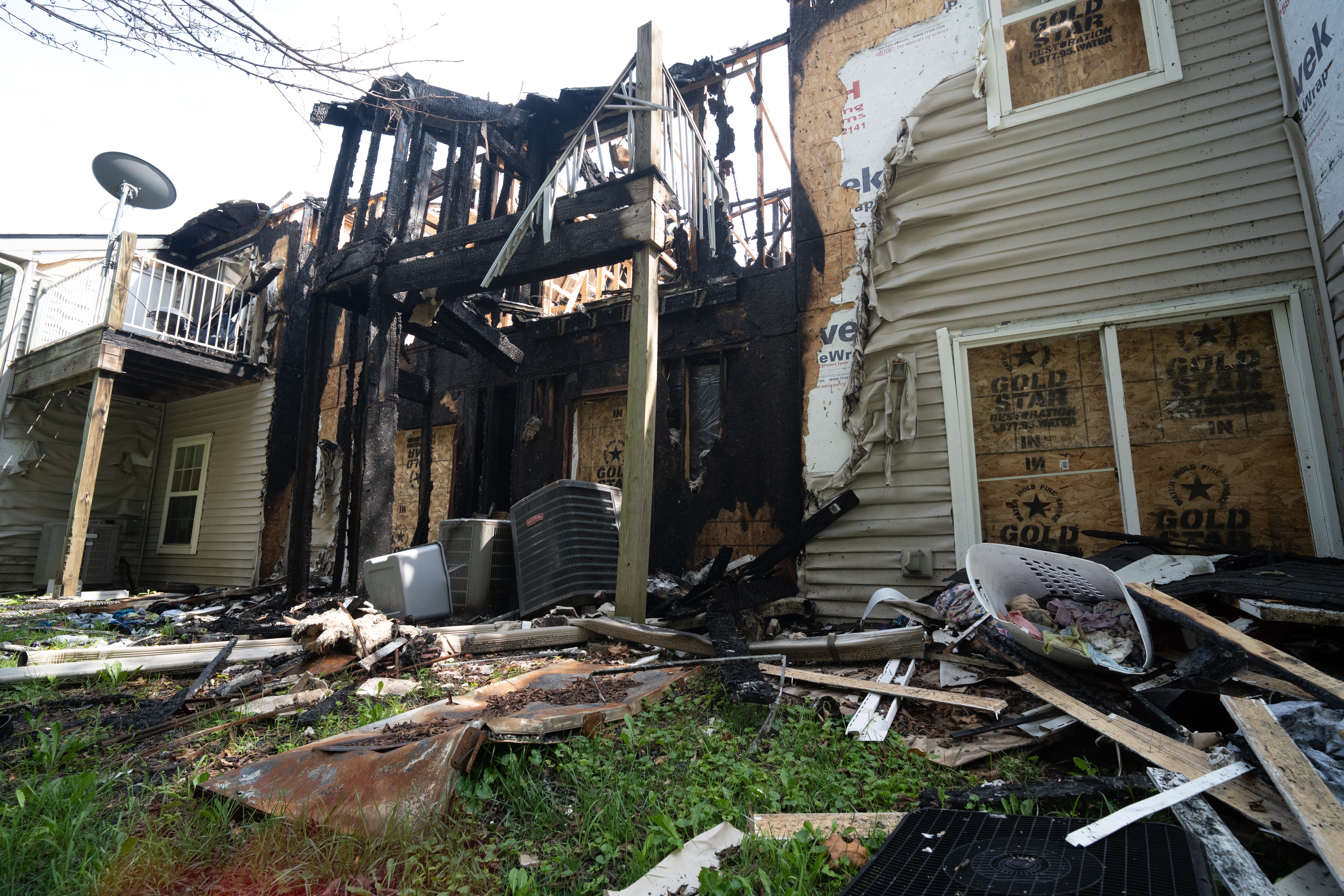
But corner cutting is still a characteristic of modern HUD supported developments too. A fire caused by children setting off fireworks in a storage shed in June displaced 11 families from a row of townhouses in a 20 year old low income housing development. The news headlines were about children committing arson but the details point to neglect and poor design. An external storage shed on the back of a likely vacant townhouse was left unlocked, children up to mischief caught it on fire shortly before the 4th of July.
I personally inspected the fire damage and reviewed building code. While the building had a 3 story brick facade, the back of the building where the storage sheds attached was clad in cheap vinyl siding. Fireworks ignited exposed OSB board in the shed, easily melted the vinyl siding on the townhouse sending flames up the back wall to the roof and quickly burning thru the minimal code required blocking in the attic between units.
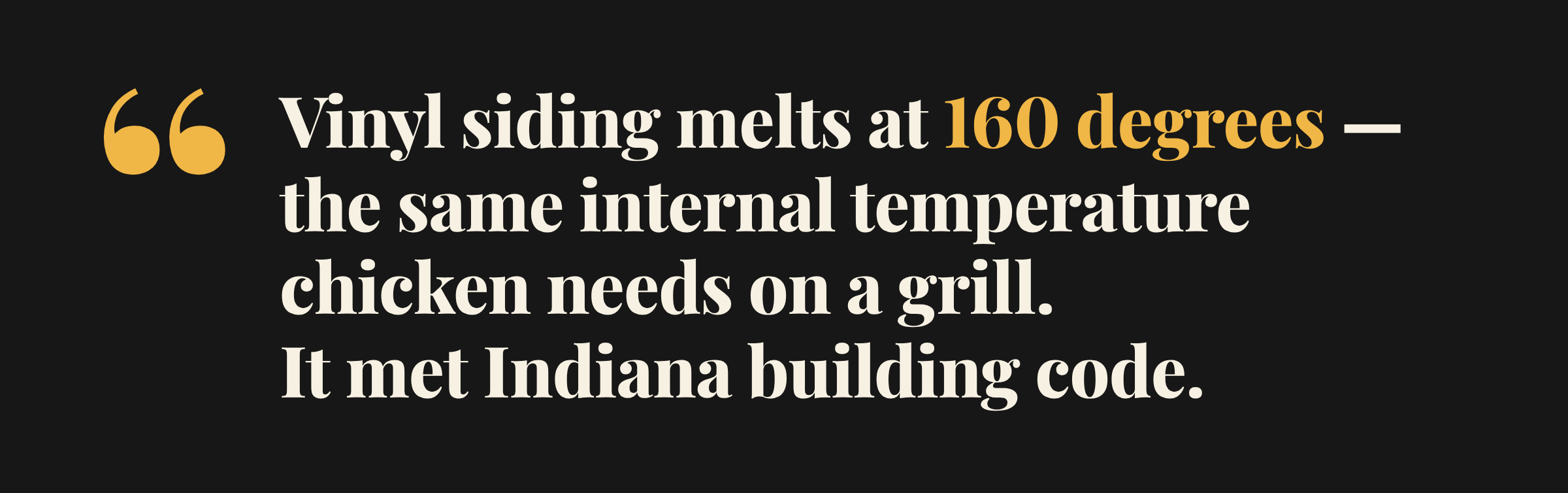
Fire resistant exterior cladding and strong attic fire blocking was already required for apartment buildings in other states when it was built because vinyl siding melts at 160 degrees, the same internal temperature chicken needs on a grill, but it met Indiana building code. Incidentally an outdoor storage shed is exactly where apartment families would store a charcoal grill.
Building to the bare minimum
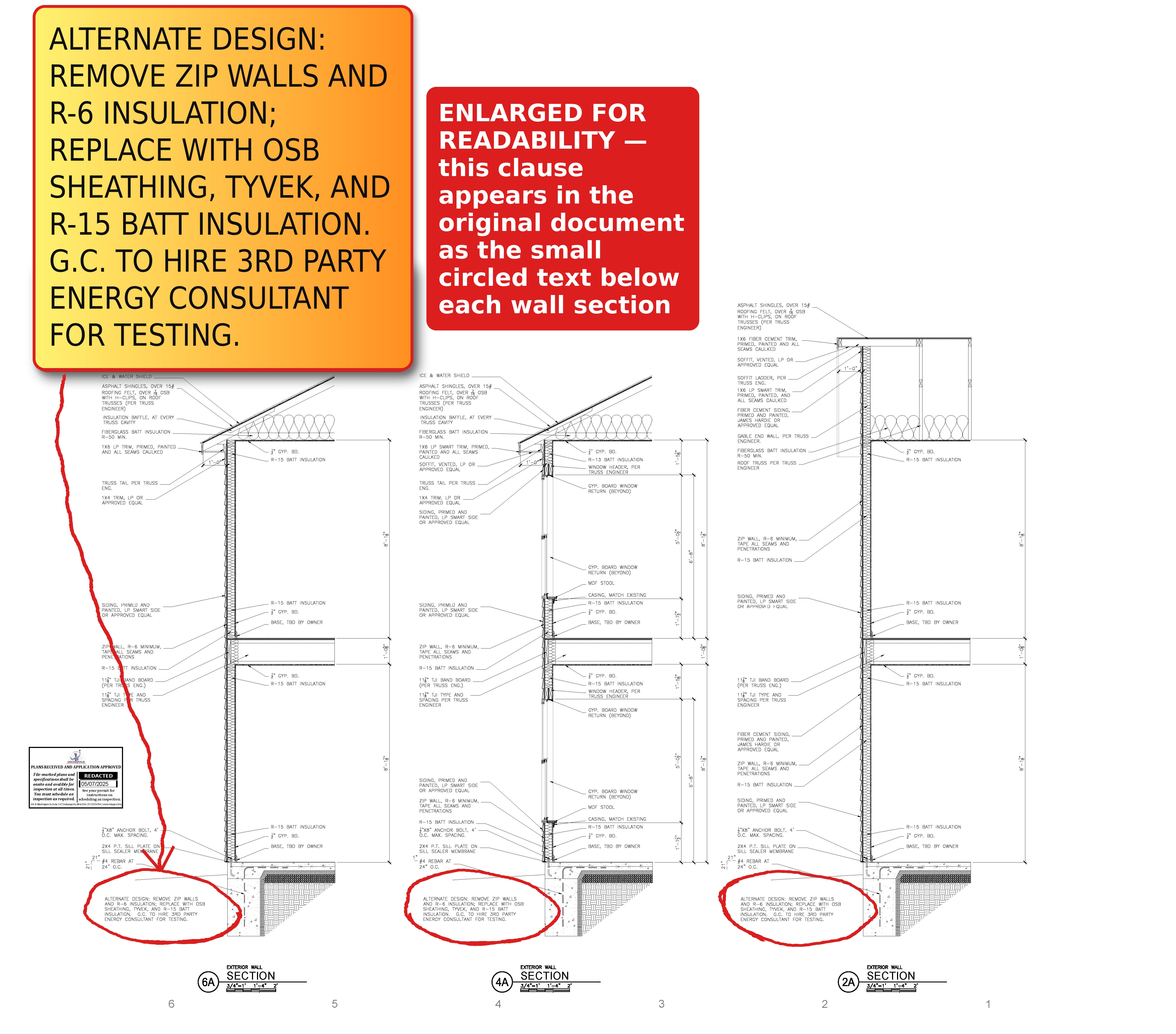
I also inspected and reviewed architectural plans for new affordable housing going up in Indianapolis for 2026 and found many plagued with clumsy design and dubious cost cutting decisions. In one development I found the actual 22 page architectural plans filed with the city of Indianapolis had an “alternate design” clause and the homes were being built with less insulation than required by Indiana’s prescriptive building code. After conversations with the contractors it was revealed they had switched to cheaper specs that their own 3rd party “energy consultant” would sign off on later after “performance testing”. This performance based energy code certification was simply a cheat code that allowed them to cheat (building) code and claim their 2 x 4 walls with R-15 insulation are as good as code compliant R-20 walls or R-13 walls with R-5 external insulation. It’s scientifically impossible.
What is R-value? Its resistance to heat flow. It’s how a Thermos or Yeti cooler keeps hot things hot and cool things cool. Higher R-values are better, and adding some insulation on the exterior is best.
These cost cutting changes will lead to their tenants paying hundreds more a year for utilities and homes more susceptible to water intrusion and mold. It should be noted the architectural plans filed with the city of Indianapolis by the developer indicate 2 x 6 walls, Zip system R-6 wall sheathing (an integrated weather resistant barrier/external insulation) with standard wall cavity insulation that would have delivered increased energy savings, mold resistance, longevity and met building code.
Beyond those gripes most of the projects satisfied the low minimum standards allowed by Indiana building code. These standards make for noisy homes, townhomes, and apartment buildings more likely to have maintenance issues, mold, pests, higher energy consumption, reduced fire resistance and longevity. In 2019 the US census bureau reported over 11% of US households had seen mice and rats in their home in just the last 12 months, even more had seen cockroaches and nearly 10% had reported water intrusion into their homes. This is why it’s common to see even market rate apartment complexes undergoing renovations at year 15.
Instead of steel roofs that last 50 years, asphalt shingle roofs needing replacement every 15 - 20 years are used, often with no/low overhang to provide protection from the rain to exterior walls. Leaky exterior walls insulated with cheap fiberglass that molds and loses its insulating properties when it gets wet. Exterior walls that not only stay hot or cold but are noisy and much less fire resistant than walls densely packed with better insulation. Plumbing, flooring, subfloors and drywall that aren’t built for families. Poorly insulated HVAC ducts routed thru attics reaching 140 degrees in the summer and freezing temperatures in the winter, leading to utility bills that are 15 - 20% higher. All of these decisions result in uncomfortable homes that are prone to pests, poor air quality, rot, mold, and require frequent renovation.
Build it to last
Design upgrades like routing HVAC ducts only through interior spaces instead of attics or crawl spaces are free and raised-heel trusses cost virtually nothing and together reduce energy costs by 20 - 30%. For the last 15 years the US Department of Energy and industry professionals have dedicated webpages and entire websites to encourage these innovations. By 2013 Habitat for Humanity was already building Net Zero affordable housing in Michigan that generates as much power as it consumes each year.
Today Net-Zero/Zero Energy and Passive House certified homes and multi-family housing that consume 40 - 70% less energy are being built as affordable housing all over the Pacific Northwest, Minnesota, Michigan, Pennsylvania, New York, Massachusetts, and Illinois. Most of these are traditionally built wood frame houses and buildings that could easily last for hundreds of years with only basic maintenance. Some state and local governments now require building to these standards. Even Gary, Indiana has a 38 unit Net-Zero affordable housing development.
Comfortable, long-lasting, energy efficient affordable housing is being built for a 0 - 3% premium for apartments and townhomes and a 3 - 5% premium for single family homes. In fact when I reviewed architectural plans for the market rate duplexes and 4 unit townhouse rows going up in my neighborhood and calculated the cost to build to higher standards along with a 50 year steel roof, the upgrades paid for themselves years before the first shingle roof replacement would have been needed. Smaller (less expensive) HVAC systems, lower utilities, maintenance and insurance costs would have paid for the upgrades within 15 years of ownership.
We’re harming our environment through excessive building energy consumption and constant demolitions and renovations ending up in a landfill. But we’re harming our health too with poor indoor air quality in many homes with water intrusion and mold fueling a rise in asthma and other health disorders. Building with the long-term health of the occupants leads to long lasting buildings, money savings and additional benefits for our environment.
Ownership that serves renters

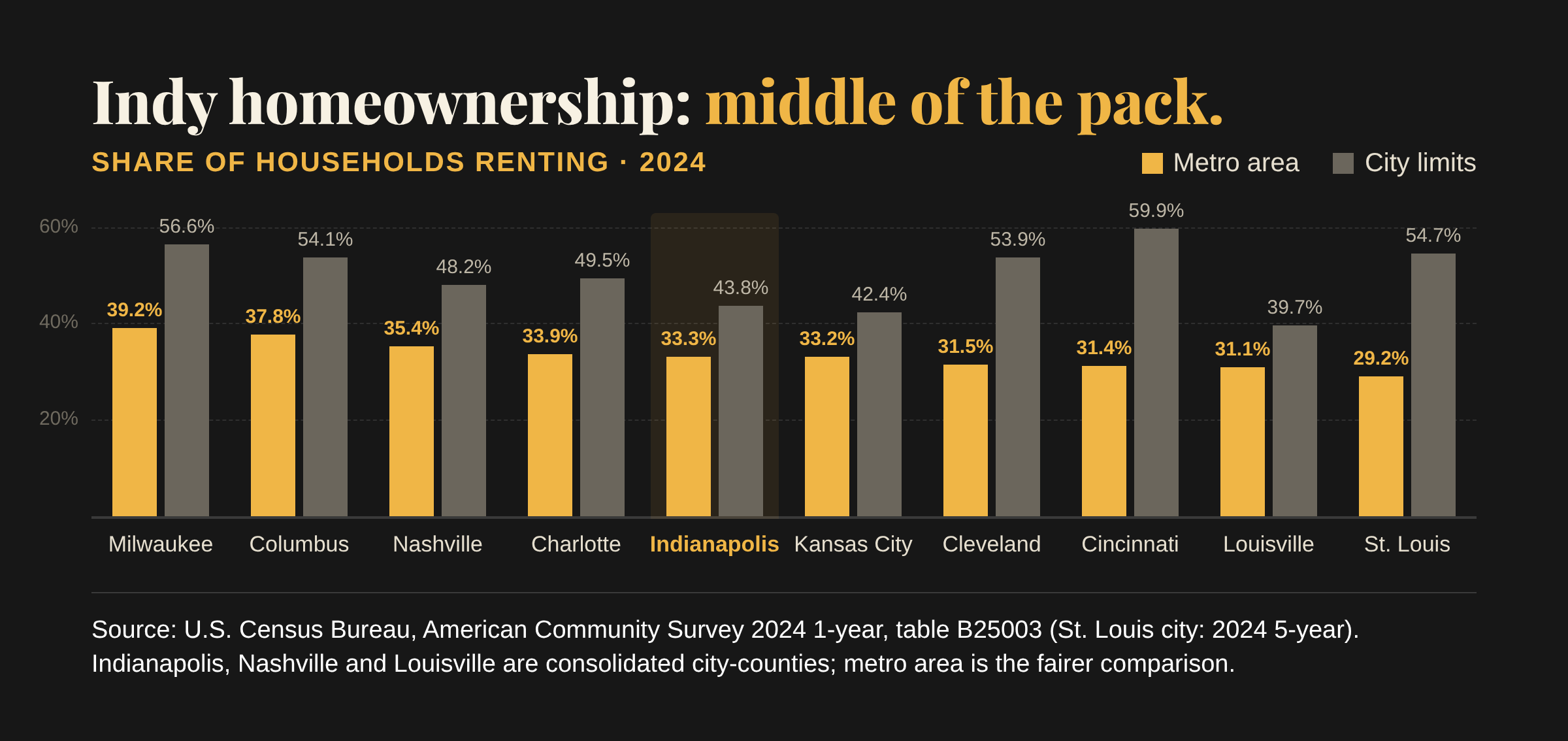
The Fair Housing Center of Central Indiana reported that landlords filed nearly 19,000 eviction cases in Marion County/Indianapolis in just the first 9 months of 2025. It also found renters in predominantly nonwhite neighborhoods were more likely to be evicted. Indianapolis has a lot of people renting and things aren’t getting better especially for people of color. But the percentage of households renting vs owning their homes isn’t at all abnormal when compared to other cities. In fact out of 10 peer cities Indy is in the middle of the pack with 33% of the Indy metro area renting and 44% within the city limits. These statistics show Indy’s housing crisis isn’t solely caused by low homeownership and shouldn’t be address as such because the issues are more nuanced.
Indiana Realtors report only 36% of Indiana home listings are affordable to middle-income households anyway and that it now takes 7 years for Indy-area residents to save up for the median down payment amount of $29K. Despite Indianapolis rents skyrocketing through the pandemic owning a home is now 34% more expensive than renting too. Low and middle income residents are in a no-win situation with high rents in a state with few protections to protect tenants from bad landlords or resources for dealing with a financial crisis before eviction. All of this in a housing market where homeownership that was already out of reach for many, now seems increasingly pointless without any real savings.
People who rent homes and apartments i.e. (renters) are humans that deserve more than just reactive advocacy through poorly funded eviction prevention programs. Community land trust models like the Indianapolis Community Land Trust and cooperative models lock in affordability of housing units by joint tenant ownership of land and/or the buildings themselves through a nonprofit. Land trusts often allow for traditional home mortgages that allow limited profit to homeowners on resell and cooperative housing models can offer limited equity to achieve the same goal. These models make it easy to allow households to enjoy a high degree of housing stability no matter whether they’re living in an apartment, townhouse or single family home.
Common criticisms are that residents don’t reap the windfall of potentially selling their homes for market rate prices. But when 44% of Indy and over ⅓ of metro area households are renting without any meaningful protections, is home equity what everyone prioritizes in their lives? Is it the main priority for every worker in our great service economy of Indy’s hospitality and convention industry to leverage their home buy for a bigger home when they’re currently struggling with fair rents? Are Indy’s essential workers in traditionally low paying jobs all hoping to buy homes with the intention to use home equity loans to fund their startups? Certainly some of them, but most would want the option of stability and a safe affordable community for their families to thrive.
And even if a community land trust or housing cooperative is widely successful they still represent less than .1% of the total US housing stock and the Free Market will always be there for those who want to try to maximize profit on a future home sale. There are great opportunities to create financing, ownership and rental models that provide safety, stability and comfort for the numerous households currently renting.
Philanthropy exists to solve systemic problems

The systemic challenges are daunting. There’s been little reform at HUD and for years the Indiana statehouse refused to pass legislation to address the housing crisis. Local nonprofit leaders have long used this as a justification for only operating within the margins of a system it knows doesn’t work. But doing the same thing over and over and expecting a different result is the definition of insanity. We know there are systemic gaps in housing oversight at the local, state and federal level. Civic leaders have to decide whether we to continue to build whatever the system will let us get away with or instead build thriving communities. Philanthropy can be bold, try new things and make new mistakes. And by definition philanthropy exists to address systemic social problems and promote human welfare. We have options.
Local leaders must confront the bias against renters and multi-family housing rooted in race and class prevalent in city planning and philanthropy. Government officials, nonprofit executives and board members must work to better educate themselves on the housing crisis to understand how to best align and support its own organizations to address it. Failure to consider the safety, security and stability of renters is failure to see over ⅓ of US households as human beings. Beyond just listening to out-of-state guest speakers, they need to visit neighborhoods and talk to individuals living through this housing crisis.
Local government and philanthropy must collaborate to work around these systemic failures at the same time as it’s working to change the system. A tangible collaboration is city government working with philanthropy and industry experts to stabilize Indy’s broken housing agency that drives evictions, homelessness and oversees slum housing. They can work together to develop a plan and funding to renovate the hundreds of vacant units in public housing and renovate and preserve affordability in the other low income housing developments across the city. Philanthropy can immediately look at what’s working across America and visit experts architects, engineers, developers, urban planners, nonprofit and community leaders doing the work, and bring to work with their counterparts. They can work to hold their developers accountable to avoid corner cutting but also better support pre-development planning and architectural design that lead to success.
Philanthropy could immediately convene engineers, architects, planners and residents to make recommendations for zoning and building code reform that encourages dense multifamily housing development and single-family housing where appropriate and support the city of Indianapolis’ initiative to create pre-approved infill development. These would be pre-approved housing plans that work for our many under-appreciated urban neighborhoods with empty lots. Imagine with more support the possibility of pre-approved full architectural drawings for duplexes, townhomes, small apartment buildings and even single family homes too. Plans that fit aesthetically with urban neighborhoods. Plans that exceed the minimum standards that are affordable to build, safe, energy efficient and ready to be lived in long-term. Plans that already have the general costs and materials fully fleshed out for developers to use without big surprises and significant cost overruns.
Philanthropy can likewise collaborate to convene innovative financial institutions and investors together with the Indianapolis Community Land Trust and fund rental and cooperative ownership models that better serve the growing number of residents that don’t have the opportunity or desire to become traditional homeowners. It can take a holistic approach to developing dense mixed-use buildings with affordable housing in transit rich, walkable and bikeable communities with functional greenspaces that provide long-term comfort and stability to families regardless of socioeconomic status.

The point about planning getting treated as a side issue is the one that stuck with me. The 39,000 unit shortage reads like a design problem as much as a funding one, and cheaper insulation and layout choices add up over decades of someone paying utilities.
Good article Keith
I hope you have plans for follow-up writings on these issues. Some additional topics may be focused upon the lobbying power of the Builder’s Association and MIBOR.
Tax abatement or deferment to developers and builders that recoup a greater capital gains when selling off multi-family projects after ten years. Some monies should be returned to the governing agency and community.
Continued constant neglect of some of our communities by the current administration, (that’s you mayojoe). Simple street cleaning and broken window projects go along way.
My personal beef, Wildstyle, is the favorable “north side” improvements. We know who has the ear of the administration.
Best of luck.