

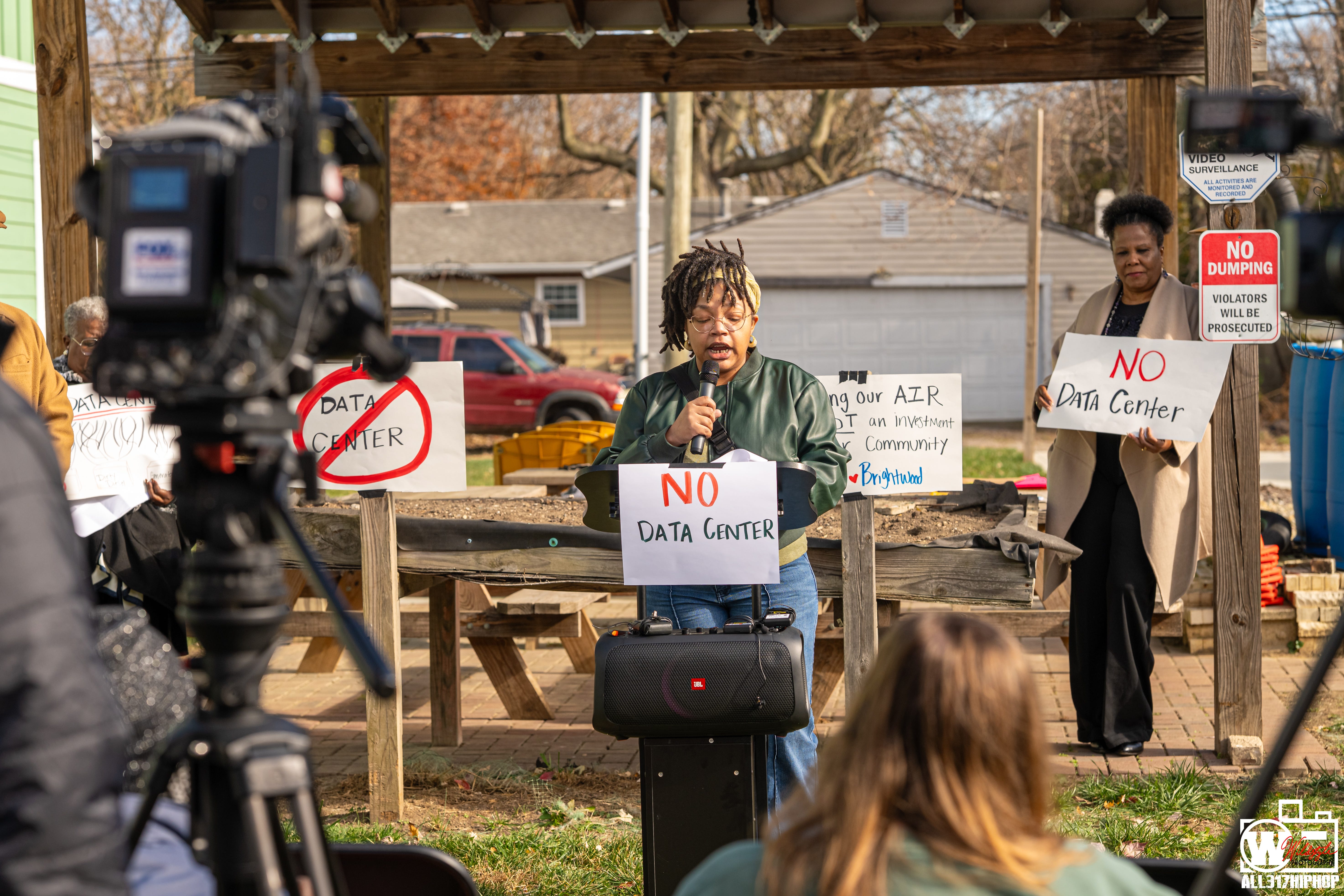
There’s been a lot of controversy in Indianapolis over the historically Black Martindale-Brightwood neighborhood’s decision to reject a data center proposal from MetroBloks. They offered a pocket park and mural in exchange for allowing them to build a $500 million data center in the heart of their urban neighborhood. After tense community meetings, press conferences, rallies, and protests MetroBloks pledged $2.5 million for affordable housing and community infrastructure to the Martindale-Brightwood. But the community still says no to MetroBloks’ experimental model of locating powerful data centers in urban areas. So far no government agency, nonprofit, or community members have been named to receive this money and no one has disclosed negotiating to receive it. The 150,000 square foot 75MW data center will be located next door to a grocery store, check cashing store and across the street from a public library, homes, and bounded by neighborhood streets on its north side. At 75MW MetroBloks’ data center would consume more power than any of the 56 existing central Indiana data centers that are mostly under 5MW.This data center will need similar electrical power as all the homes in the city of Muncie, Indiana. And it needs this power 24 hours a day, 7 days a week to operate 99.999% of the time, as advertised on its website. This will require costly infrastructure upgrades from central Indiana’s controversial utility, AES Indiana that many believe will be passed on to all Central Indiana customers. AES Indiana, already under fire for outages, poor customer service, rate increases, and faulty billing, scheduled several community open houses to address issues, but canceled them over alleged threats. AES Indiana’s parent company AES just agreed to be purchased by private equity firm BlackRock and multinational investors. And so far MetroBloks, when asked directly, has shown no agreement to pay AES Indiana for this infrastructure. They said they didn’t even have an estimated cost but assured us in a community meeting they’re good for it when the bill arrives.
Massive Diesel Generators
MetroBloks plans to use 36 massive diesel generators to back up AES Indiana. Each of these diesel powered electrical generators are the size of a full-size SUV and need thousands of gallons of fuel storage. They have to be run at least once a month but in order for the Metrobloks data center to operate 99.999% of the time these generators will have to operate whenever AES Indiana can’t deliver a small city’s worth of power to the site. MetroBloks’ attorneys assured the community the Tier 4 diesel generators they specified won’t pollute more than a school bus, but that’s a lie. A modern school bus engine produces between 200 - 360 horsepower but each diesel generator MetroBloks’ specified produces nearly 3700 horsepower or roughly 2750 kilowatts. This will produce excessive localized diesel particulate matter that Martindale-Brightwood residents will be forced to breathe on their porches, at their grocery store, cashing their checks, or at the public library. Unfortunately Indianapolis neighborhoods are no stranger to air pollution. The American Lung Association just gave the metro area an “F” in smog and soot pollution(particulate matter). Coal-fired power plants and diesel engines produce smog and soot that can cause premature death and other health hazards such as heart attacks, strokes, preterm births, asthma, and cognitive decline. The Indianapolis-Carmel-Muncie area ranks 11th most polluted area in the United States for year round particulate pollution out of 211 US metro areas. This and other data center projects will push the Indy Metro area higher up the list in the future. But for this predominantly Black neighborhood that already has a source of diesel particulate pollution from the nearby Interstate 70, additional LOCALIZED diesel particulate pollution could be devastating. Noise will be another localized byproduct of the intermittently operating diesel generators, chilled water units, and rooftop HVAC units needed for daily operations. Both noise and pollution from the data center will disperse to less critical levels outside the neighborhood. Below is video with sound from Netrality’s data center complex along Kentucky avenue in Indianapolis. This cluster of small data centers next to White River has less than half the overall square footage and not even ⅓ the power requirements of MetroBloks’ data center proposal that’s in the middle of a neighborhood. But even this complex is noisy and has already run afoul of the Indiana Department of Environmental Management for operating its 7 smaller diesel generators without a permit.
False Narratives: From MetroBloks, the know-it-all IBJ comment section, and Lazy AI powered bloggers and podcasters
“Metrobloks data center will not contribute to pollution and noise. The diesel generators pollute less than a school bus!”
Fact: MetroBloks specified 36 - 78 liter, 18-cylinder generators, as big as a Cadillac Escalade ESV, each producing enough electricity to power 183 homes. A typical school bus engine is a 6.7 liter, 6-cylinder diesel. Both engines use similar pollution control technology and the massive generator produces massively more pollution than a school bus.

“Here’s a gigantic ‘gift development’ seemingly from nowhere and locals can’t see beyond their own myopic lack of area improvement. The site has been a blank slate for 40+ years.”
Fact: The site has been vacant for 40 years. Vacant lots don’t create diesel particulate matter, ozone, and the noise of 36 diesel generators, chilled water units, and rooftop HVAC units. This is never considered a “gift development” for predominantly White neighborhoods in Carmel, Fishers, or Noblesville. Black communities are once again expected to quietly give up more of their quality of life, health span and life expectancy for few if any jobs or tangible benefits.
“Everyone wants Ozempic. Nobody wants the LEAP District next door. Everyone wants the data. Nobody wants the data center. Everyone wants the roads. Nobody wants the tolls. The future ain’t free.”
Facts: Eli Lilly and Company’s LEAP district is controversial because of Meta’s 1500 acre data center project, not Lilly’s pharmaceutical manufacturing happening there. Because data centers don’t make Ozempic, and neither does Lilly, their competitor Novo Nordisk makes it. Data centers have powered the internet since day one with little controversy. According to the Data Center Map website the Indy metro area already has 56 data centers. All of them require a fraction of the power needed for MetroBloks’ data center and other recent proposals. Smaller data centers powering access to knowledge and connectivity via the internet have always been around us with very few issues until tech companies reinvented the scale and function of data centers to power AI for big corporations. The data centers we’ve all been using for decades of internet functionality are NOT the large incredibly polluting resource hogs being proposed here by MetroBloks, Sabey, Google, and Meta.
Voices of the Politicians
So where do Indianapolis public servants stand on protecting the communities they were elected to serve? Some openly side with corporations’ right to poison neighborhoods for profit, while others quietly do the same, throwing rocks at the community and hiding their hands.
Ron Gibson, the councilor whose district the Metrobloks data center will reside in, is a staunch supporter of the project despite over a hundred letters of opposition. Not a single letter of support has come from a resident. He walked out of multiple meetings with residents and clergy over their opposition to the project and was even caught lying on local radio show about the plans for diesel generators in Martindale-Brightwood. His home, over a mile and a half away from the site, won’t face the localized diesel particulate pollution as Martindale-Brightwood residents. I’d like to acknowledge the incident of violence at Councilor Gibson home attributed to this data center fight. While asleep in his modest 1-story home an assailant(s) fired 13 shots at his front door, shattering the glass security door striking the lower half of the wooden door. The sound of his front door being riddled with bullets woke up Gibson and his 8 year old son, but he made the decision to go back to sleep, not even determining whether anyone outside needed medical assistance from the shooting. Gibson says he wasn’t sure it was his house being shot up. He would get up that morning to find a piece of paper in a ziploc bag tucked half way under his welcome mat with the words “No Data Centers” written on it. He would send his son off to school and finally call Indianapolis metro police 8 hours after he heard the shooting. The police arrived in 15 minutes. No one was injured in the incident and so far no arrests or suspects have been announced. If you have any information about this incident please contact IMPD or the FBI.
Joe Hogsett, mayor of Indianapolis has had his spokesperson tell the press that his administration does not involve itself in zoning decisions after being asked by the community to intervene in this data center. But Hogsett’s staff at the Department of Metropolitan Development recommended approval for MetroBloks’ data center despite it violating their land use plan and transit oriented development guidelines. Indy Economic Development, an organization chaired by Mayor Hogsett negotiated tax abatements for this and other data center projects and sent a letter of support for MetroBloks. No matter how many times in the last decade whenever departments, agencies, and organizations under the direct control of Mayor Joe are caught doing tangible harm to the Black community in Indianapolis, Mayor Hogsett says every time “It wasn’t me” just like Shaggy’s 2000 hit song, and keeps going.
Vop Osili, a city councilor and 2027 mayoral candidate voted in January with Councilor Gibson against a resolution that narrowly failed calling for a moratorium on data centers until they could be regulated appropriately. 3 other Indiana counties already had such data center moratoriums. Councilor Osili said at the time that he’d already drafted a proposal “which provides guardrails, outlines prohibitions on where a data center might possibly go” but when Martindale-Brightwood leaders unexpectedly received a continuance the next week delaying approval for the data center another month, Councilor Osili’s proposal never materialized. He would eventually sign on to a letter from multiple councilors in February supporting the community and asking MetroBloks to withdraw, however the letter was only sent to the press, 30 minutes before the 1 pm hearing, after most of the media were already in the City-County Building assembly room. None of the councilors showed up to testify or stand with the community. Martindale-Brightwood residents wouldn’t learn of this “support” until after the data center was approved in the hearing. Osili wouldn’t publicly post the support letter until later that night, roughly 7 hours after the hearing. For hundreds of years this was a common tactic that got many generals and military leaders court-martialed for intentionally showing up for battle after it was over.Their performance didn’t go unnoticed either. I awarded these 6 city councilors the Most Performative Public Service award. Interestingly enough, Councilor Osili’s employer, international architectural firm Woolpert has designed more than 95 million square feet of data centers around the world for Meta and other tech companies. The architectural firm enthusiastically shared Vop Osili’s mayoral campaign announcement to their 47,000+ LinkedIN followers wishing him ‘nothing but the best’. Osili is a program director for Woolpert’s Indianapolis office and donor to their political action committee. Osili’s public position in an Indystar article that data centers are infrastructure like “power lines, telephone lines, and sewer lines” may have rubbed some the wrong way but echo company policy at his employer, Woolpert.
The Urban Experiment
So is the modern Negro too uppity appreciate diesel particulate matter? It would seem so and previous generations weren’t any different. According to Martindale-Brightwood’s Quality of Life Implementation plan, complaints and legal actions about the dangerous industrial pollution in their neighborhood began as early as 1930 but were ignored by the racist power structures of the time. Eventually parts of Martindale-Brightwood would become an EPA Superfund site and the neighborhood would be connected with higher rates of chronic illnesses and cancer. This may just be “politics” for some but it will very much be life and death for others in the community. Metrobloks’ experimental data center model to place powerful data centers in urban neighborhoods will be much like the Tuskegee Experiment because we already know the effects of diesel pollution are bad. Tech companies and politicians have underestimated the resolve of Black communities to fight the business interests attempting to endanger their health for a quick buck. What Indy politicians Black or White need to do is quit listening to and peddling disingenuous talking points and misinformation from corporate interests making profits at the expense of people’s lives and ask themselves a few simple questions. The question isn’t about whether any of us use the internet when data centers have powered the internet since day one. The real question is when Meta can lay off 8000 employees soon after breaking ground on a 1500 acre $10 billion data center campus north of Indianapolis, who are these new resource draining data centers being built for? Is this boom really all coming from tacky AI flyers and ChatGPT prompts or are multinational corporations driving demand so they can replace as much of their workforce as inhumanely possible? And how many of us do they get to kill to do it? The idea that this is just politics is a misnomer itself, when both Democrats and Republicans work together to poison their own constituents and make them pay for the privilege through tax incentives. This isn’t about stopping the rise of AI, it’s about ensuring communities are safe.
Non Violence Is Not Silence
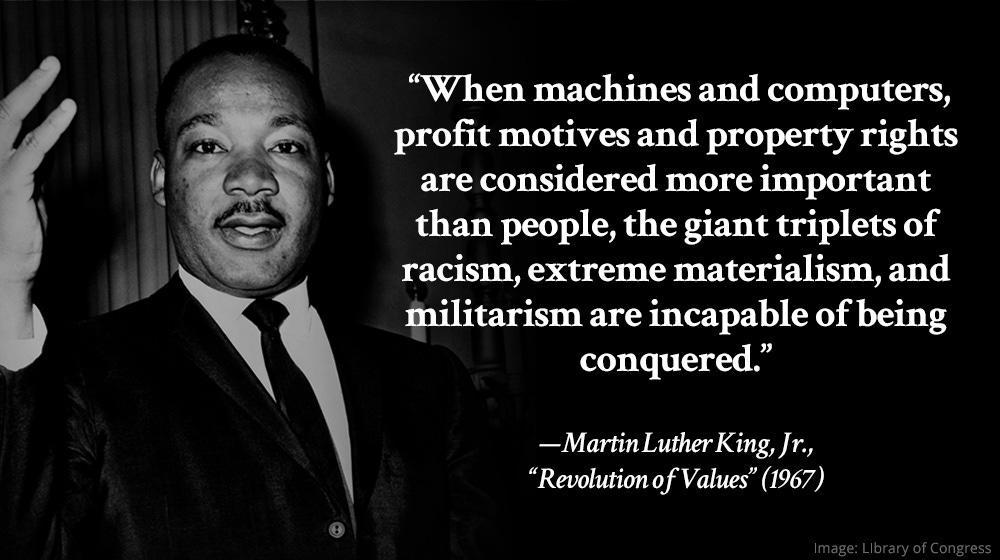
Dr King preached nonviolence as Indianapolis community leaders and advocates do today but he also acknowledged that “riots do not develop out of thin air” and said “a riot is the language of the unheard.” Community advocates organizing and educating their communities about the issues affecting our lives are no more responsible for political violence, real or staged than the person who filmed the murder of George Floyd for the 2020 riots. Community advocates and activists will not keep the violence done to our communities a secret just like civil rights leaders of the past could not stay quiet. Indianapolis residents of all races, creeds, and colors have shown up peacefully to say we care more about safety for our families than corporate profit. Not just in Martindale-Brightwood but Franklin, Decatur, and Pike township as well. But are elected officials listening? Next year’s municipal primary is May 4th 2027 and one town in America has already voted out half its town council over these issues. Mayor Hogsett and Indy City-County Council have to ask themselves: Are they going to protect the health and lives of our constituents or not? The community is tired of the lies, semantic arguments, false friend and delay tactics being used and will tolerate it no longer.
Amazing work as always! Thank you for writing this!!
Thanks for this. It's shocking but not surprising. No coincidence that they're targeting Martindale-Brightwood: These kinds of data centers are already being built in predominantly Black neighborhoods all across the South.